ChatGPT's About to Run Ads. Even if you have no interest, your Content Needs to Be Ready.
OpenAI has started testing paid ads in ChatGPT. They show up at the bottom of answers for users on the free tier and the new $8/month "Go" plan — labeled as sponsored, targeted by what you're talking about. Trip planning might surface hotel ads; product questions might surface brands. OpenAI has been clear: ads don't influence the answers, but they do add a new way for brands to show up in front of hundreds of millions of weekly users.
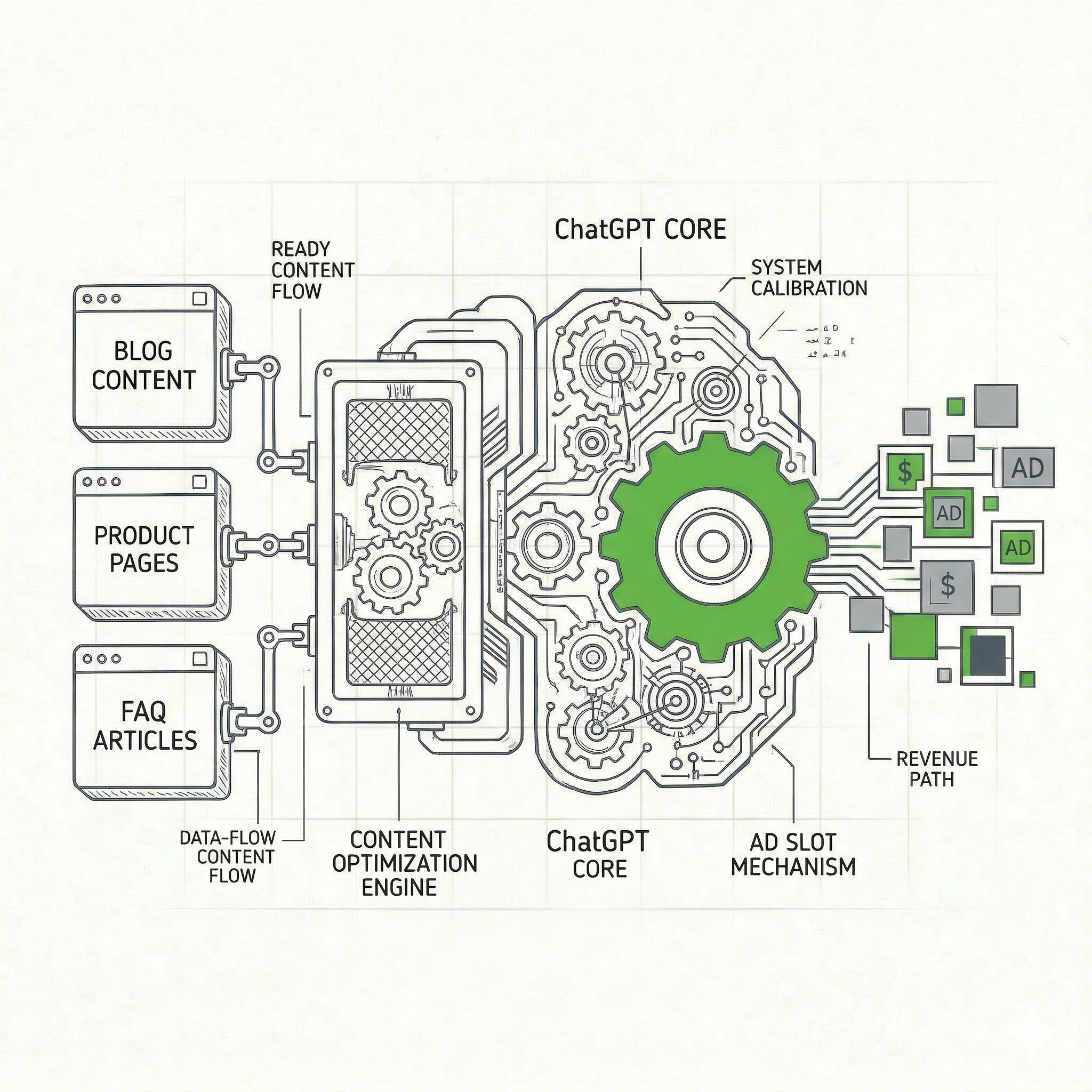
So what? Two things. First, paid placement in AI is here. If you've been treating "AI visibility" as tomorrow's problem, tomorrow is now. Second, the brands that show up first — in answers and in ads — won't get there by accident. They'll be the ones whose content is already findable, citable, and coherent enough for both the model and the ad systems to use.
This isn't about gaming ChatGPT. It's about getting your house in order before the landscape gets noisier.
Why This Moment Matters
ChatGPT has roughly 800 million weekly users. Early ad tests had CPMs around $60 and minimum commitments in the hundreds of thousands for some brands. That tells you who's serious about buying space. Buying space only works if users already associate your category with you — and that association is built on what the model was trained on, what it can retrieve, and what it cites.
If your content is messy, vague, or buried, you're harder to cite. If it's clear, structured, and authoritative, you're easier to surface in an answer. When ads roll out more broadly, the advertisers that win will be the ones that already "make sense" to the system. Your content is part of that.
What "Being Ready" Actually Means
You don't need a ChatGPT strategy doc. You need the same things that help with AI search and GEO in general:
Clarity. Your pages should state what they're about and answer the question they promise to answer. Clear headings, clear entities, clear intent, it makes your content easier to cite and easier to match to a query.
Structure. Headings, lists, definitions. So an AI (and a human) can parse you quickly. No walls of text with the key point buried in paragraph seven.
Authority and trust. Author bylines, expertise signals, and content that demonstrates you know the topic. E-E-A-T isn't a checkbox; it's what makes you a plausible source instead of random web noise.
Technical basics. Crawlable, fast, well-linked. If your site is broken or slow, you're already behind.
Optional but useful. LLMS.txt and other metadata that tell crawlers and systems who you are. As we wrote in our GEO checklist, we treat these as low-cost layers, not magic. The heavy lifting is still on-page.
Ads vs. Citations
Ads are a paid channel. Citations in answers are an organic one. They're different levers. Preparing your content helps you with citations and with being a coherent brand when you do decide to spend. It doesn't replace strategy or budget — it makes both more effective.
If you've been putting off "AI optimization" because it felt early, the rollout of ChatGPT ads is a good reason to stop waiting. Not that you have to advertise tomorrow, but the window where organic clarity still has outsized impact is closing as paid placement grows.
The Bottom Line
ChatGPT is rolling out ads. The brands that show up first in answers — and that get the most out of ads when they run them — will be the ones whose content is already findable, understandable, and citable. Get your structure, clarity, and technical foundation in place now. Then decide how much you want to play in paid when the time comes.